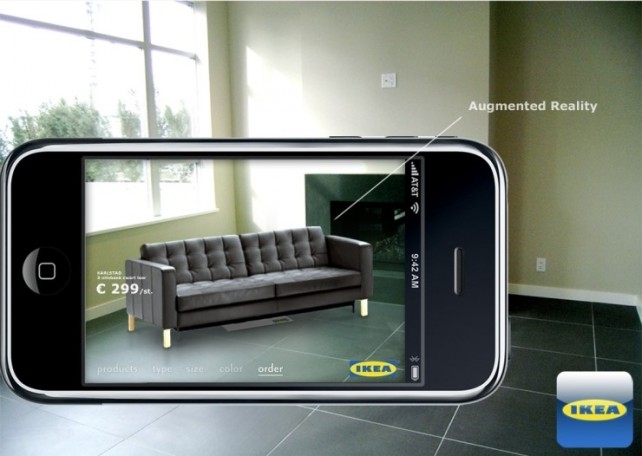
Ever wondered what sofa could you put in your living room, what color? What size? L-shaped or not?
We know…it’s hard to find out on a catalogue....... and that’s where Augmented Reality and IKEA can now address your problem!
With their new application, IKEA has taken the next step by moving their show room to your home. Just take your iPhone or iPad scan a page of the catalogue and voila you can see your new couch in your living room!
Want's a new sofa?
How about a new shelve?
"Offering a way of using mobile technology to enable to test products means the technology has a practical purpose and really helps customers visualize the way their homes could look." said Peter Wright, country marketing manager of Ikea in the UK and Ireland.
Check out how it works in this really cool advertisement
Have you already tried it? Let us know in the comment below what do you think about this app!
A few years ago I read a book, Super Sad True Love Story, a dystopian love story about people obsessed with superficiality driven by their wearable technology. The wearables, called "apparats" in the book, allow everyone to see instantly how everyone rates everyone else's attractiveness, called a "fuckability" rating, in a bar or any other social environment. Everyone rates everyone, constantly. The book was published in 2010 and in the three years since I read it, I've seen many aspects of the book slowly come true.
Imagine my horror when I discovered a new app, Lulu, which allows women to rate men with a number evaluation and hashtags such as "#ObsessedWithHisMom and #GoneByMorning." Despite Lulu's claim that this is "unleashing the power of girl talk" and my position as a proud feminist, let me confirm that I find this app straight up creepy, not to mention cruel. No one should have to have to relive a history of dating missteps each time they meet someone new. Many men agreed that apps like Lulu aren't ethical, and in response Lulu has now required that men opt-in to the site.
How long will it be before technology like this is wearable and part of augmented reality? How long will it be before your Tinder "swipe yes's" are recorded and shared? Before your crowdsourced physical desirability is viewable in glasses or contact lenses? What effect could this have on our dating behavior?
In this video, one woman takes a comedic look at how Google glasses might affect men's dating behavior.
Pushing the bounds of wearable apps, we can envision more disturbing situations, as seen in the video "Sight" below:
How ethical is it for someone to research you on social networks before a date? For them to use an app to improve their dating "performance"? Are these technologies a boon for the socially awkward or a manipulation of your dating partner?
Personally, I'm a bit old-fashioned about this stuff. If I pay more attention to my phone than my dinner date, at the end all I've earned is a closer relationship with my device. I do my best to keep my phone in my bag, but wearables combined with augmented reality technology imply that our attention has the potential to be constantly divided. The idea of a guy using an app to take me home would certainly feel like a manipulation... if I found out. But what if I didn't? Would ignorance be bliss?
It's possible that companies that advocate for wearables and the associated apps will succeed in shifting public opinion to become comfortable with these technologies and potential privacy invasions that they present. Alternatively, some trends indicate that people are becoming less comfortable with their private information being public, even on current social media. For example, many reports indicate that teens are abandoning Facebook and flocking to Whatsapp and Snapchat precisely because these apps allow them to more strictly control the audience that sees their information.
My prediction is that we will become more comfortable with wearables at the same time as we seek to share personal information with only a smaller, tighter network of who we consider our real friends, not our "facebook friends."
So far we have discussed some of the applications of
Augmented Reality (AR), such as in medicine, in this post we will be discussing
AR in education. In the area of education AR has incredible potential, so
far there has been some advances, but there is a lot more that can be done in
order to increase significantly the value to the learning experience on every
level. There is no better way to learn than interacting with the
objects we are learning about. Imagine a second grade teacher reading a book to
their students, as she mentions some of the characters of the story they
come alive and kids can interact with them. This will bring storytelling to a
whole new level.
Now imagine a student trying to study the human body and
its parts reading and listening are essential for education, no question about
that, but education deepens when we include creation and interaction. It is not the same for students to read the content from a textbook than interacting with a body. There are
apps already in the market that do exactly this. For example, Anatomy 4D,
which you can download from your smartphone or tablet, allows you to print out images from the human body just as the ones we
see in regular textbooks. But the magic happens when you use the app and
overlay your device over the previously printed images, the student can then engage into an active learning experience getting to know the body parts in a
more interactive and fun way.
We could think of many other topics such math,
science, history and many others where augmented reality will revolutionize the
learning experience making it more digestible, interactive and certainly more
fun.
The following video is a perfect example of little girl
in third grade using her iPad to solve a math problem. The moment she overlays
the iPad over the paper where the problem is, she can watch an interactive
explanation helping her to figure out the solution.
Every day we continue to hear how school systems, all over
the world, should put more effort into fostering problem solving skills into
students from all ages. We think that AR could bring many solutions to this
global need. AR could be used along with
Project Based Learning, which is a method where students gain knowledge and
skills by working for an extended period of time to investigate and respond to
a complex question, problem, or challenge. AR is the perfect way for groups of
children to thrive in a project based learning environment. Each child can use
their Augmented Reality capable device to build or help solve problems.
Nowadays practically every teenager owns a smartphone,
teachers in schools and universities battle every day to prevent students from
using their smartphones/tablets during lectures. Wouldn't it be more beneficial
if teachers could leverage this fact to encourage students to use their
devices to learn on different topics through AR? We see a lot of opportunity in AR
in the future, we wouldn't be surprised to see textbooks replaced by this
technology or at least watching them working together in every classroom.
Books in the future will most likely be adapted to suit this technology. So we
must ask, is AR the future in Education?
One of the areas in which Augmented Reality is really making a difference for everyone is medicine.
As the process of decoding the human genome continues, 23&me has become one of the most known services in genetics. This company provides you with a detailed genetic analysis that shows how prone you are to certain diseases or conditions. At the same time, you can build your own family tree and see how the mixture of different families and races increases or decreases the likelihood of certain conditions. And finally, you can get in touch with people that have similar genes as you and try to see how specific genes affected their lives! All this is achieved through a $100 mail-it-yourself kit, which includes a small medical apparatus for you to send a blood sample.
So what does Augmented Reality have to do with this? Well this is the first step, as the world we live in is characterized by exponentially growing information and increased interconnection of data. Imagine you are enjoying an afternoon trek in Cinque Terre, Italy, and suddenly fall and get a concussion that knocks you out. Your partner rushes you to the local hospital, where the physician gets instant access to your digital records just from your thumbprint. She sees all your information in a tablet or even wearable glasses, which could even tell her instantly your blood pressure, locate the hematoma at the place of trauma, and show your white and red blood cell movement. There is no loss of precious seconds to take care of your injury. Now imagine the same situation, but you have a heart attack in the streets of Pasadena. Think of how valuable that information would be for the paramedics treating you and how much more prepared the doctors would be when you arrived at the hospital.
Even further, imagine being able to perform DIY checks for your blood pressure, sugar levels, calorie intake or even weight that automatically record your levels and maintain updated daily records accessible to your doctor to track daily variance and how you stick to your diet. It's possible that your bathroom mirror could provide your daily checkup while you brush your teeth!
Did you know that less that 20% of all doctor's appointments require that the physician actually touch the patient? That means that 80% of diagnostics could be performed remotely, via chat or by sending pictures. This could allow patients to speak with a doctor quickly, prevent unnecessary visits and transaction costs, and sensibly reduce healthcare expenses. These developments, along with the preventive diagnostics of small and relatively inexpensive wearable devices, are completely changing the medical environment. Companies are even making the devices more imperceptible and even fashionable to prevent the embarrassment of carrying an ugly medical device.
These changes will also affect more intense and invasive procedures. How many people avoid their checkups because of the way colonoscopies or prostate exams are conducted? Imagine how many diseases could be prevented if people were able to virtually go through those procedures. The technology is almost there, and the initial trials are being carried in order to avoid intrusion on the patient, one of the biggest traumas during certain exams. At the same time, robotics and augmented reality are tearing down the walls of physical presence of doctors during procedures. Some surgeries have already been conducted with physicians located miles away and operating a terminal connected through the internet to the operating room. We can now even have a multidisciplinary team of doctors in 5 continents and participating together in the same surgery. They could see your whole diagnosis, identify possible problems during the procedures, and react faster to them.
Imagine the implications for remote or underserved towns that currently lack facilities due to high costs and low populations. Specific modern hospitals could be built at almost no cost and with little staff with a few minor futuristic devices and physicians with regular office hours connected by Internet. We could virtually build a hospital everywhere just with the internet and electricity.
Scientist are already testing the "cancer pill", a pill shaped analysis tool that will screen your whole body from inside and detect the possibility of cancer surfacing, converting damaging control medicine into completely preventive medicine. This type of pill is being tested for diverse diagnostics, and we could consider them to be a part of our routine weekend check-up while they transfer tons of data to our files like the Spider Robots from Minority Report.
Other implications for medicine include advancements made in prosthetics and the possibility to build functional exoskeletons for disabled persons and allow them to walk again. Even more, initial trials are being done to get 3D printers to create organs! This will allow thousands of people waiting for organ donors to get organs quickly and prevent potential rejections due to incompatibilities, as they could be designed from scratch to match the patient.
All these developments are making medicine more personalized, so the doctor of the future will prescribe the drug you need to cure your problem and not a generic cure based on a generic condition. Physicians will know how you react or how people with your genes react to the common cold and know that Drug X is much more effective than Drug Y. This information would continue to build your personal file and the personal files of thousands of people worldwide that share part of your genes...
Augmented Reality is building a faster, more efficient, and personalized health system. Imagine medicine based in prevention, doctors that are constantly updated about patients' developments even though they are miles away, and people proudly using sleek and fashionablecheck-up devices that screen them for diseases without being invasive.
For further information, we recommend these two amazing talks about what the future is weaving for augmented reality in a medical environment:
In the previous two blog posts we have given you a small introduction to Augmented Reality (AR) and seen the difference between Augmented Reality and Virtual Reality. In this post, we will look more at the history and evolution of Augmented Reality.
Augmented Reality as a concept is born
For most people AR as a concept can be seen as something very new. And the introduction of new products and gadgets like Google Glasses has created an increased awareness around it, and is sometimes referred to as the "wearable revolution". But as this blog will show you, AR, is a lot more than just wearable gadgets. When that is said, similar to most technologies, AR has been present in labs and research institutions for nearly half a century. The introduction of AR, can be tracked back to Ivan Sutherland, a scientist from University of Utah who in 1965 introduced a head-mounted display, with mirrors attached, allowing the wearer to see a very limited virtual world superimposed on the real world. The display was too heavy for a human head to carry, and was therefor suspended from the ceiling in the lab (See below for pictures)
Source: http://www.computerhistory.org
Augmented Reality as a name is born
The name Augmented Reality (AR), was first introduced in 1992, by Tom Caudell, working for Boeing. He was working in an area where also the US Army and related industries was looking at Augmented Reality, as a way to improve their manufacturing and engineering process. They used AR to present very simple layers on top of the real world (i.e. in the process of laying cables in certain airplane components, the software and the hardware, could indicate where which cable should be placed, without the user having to look up in manuals for every single one)
During the 90s there was a rapid technological development, which also lead to a rapid development in the space of AR. 1999 is by many seen as the turning point for AR, when Hirokazu Kato introduced the ARToolKit, an open source software package which is still one of the main technologies used for today's AR applications. The software would be taking output generated by a simple camera and overlaying it with simple virtual 3D objects
Augmented Reality today
As we moved into the new century mobile computer devices became more apparent (including mobile phones and smart phones), we saw the introduction of GPS and compasses into mobile devices and wireless data communication was introduced. All this created a foundation for several projects looking at combining this with camera processing (Cameras was becoming integrated into phones). And as of this, we saw the introductions of different Augmented Reality Browsers, which basically uses the camera on your smartphone, the GPS and data available on the World Wide Web, to display virtual information on top of the image of reality you see in your display. Examples of such browsers today are Accrossair, Google Goggles, Google Skymap etc
Then as many people are aware of, Google launched its Google Glasses for developers and testing in February 2013, and is expecting to release them to the public during 2014.
So looking at what Sutherland came up with in 1965, Google now is taking the same concept to the next level. Google Glasses are now more like a wearable computer, with a small optical head mounted display and will display smartphone like content in a hands-free fashion and you can communicate with it through your voice. Stay tuned for more information around today's
usage of Augmented Reality and the gadgets available, or soon to be.
In the previous blog, we referred to augmented reality as the
computer systems that overlay a virtual 2D or 3D model to the human perception
of reality -- all in real time!
In this blog, we will see how “Augmented Reality” works.
To understand how augmented reality works, we first need to differentiate "Augmented Reality" from “Virtual Reality”. Both augmented reality and virtual reality are generated by computer
systems. But their similarity ends there.
Virtual reality is an interactive 3D digital environment into which you are completely immersed. Everything you
experience in virtual reality – what you see, hear or interact with - is all within
and limited to the virtual-world. The virtual-world is completely
distinct and unrelated to the real-world, as you cannot sense the virtual-world or the objects in it. For instance: in virtual reality you may experience driving a car, but in reality you may not even be sitting in one.
Virtual Reality: Distinct virtual and real world environments.
Augmented reality, on the other hand, has digital information
overlayed on the real-world you are experiencing. Your sense of the real-world
remains unchanged, and it is only your perception that is being enhanced. The digital
information overlayed on to the real-world could be any kind of information – text,
image, map, blueprint, 2D or 3D model, animation, video, etc. Considering the car driving experience, here you will be driving a real car in real world, and augmented reality will overlay your view of the world with additional information that will enhance your experience. In the following images, augmented reality adds information such as distance in km, speed limit, navigation, traffic warnings, and other alerts.
Augmented reality can be conceived as – bridging real and
virtual worlds.
Because of the nearness of augmented reality to the
real-world, it is much more interesting and finds far more areas of application
than virtual reality. The success of smart phones has boosted the practical application and use of augmented reality. As a result, since 2009, "augmented reality" has been a more commonly searched term on Google than "virtual reality".
Interest
over time: "augmented reality" vs "virtual reality"
(source: Google trends)
Smart phones and wearable devices, such as a Google glass, act as enabling devices for augmented reality. Essentially, augmented reality works by using the camera on the device to examine the surrounding world, feeding that image to the device's computer - which processes the image, gathers GPS coordinates and pulls data from the Internet. The device then projects the information onto the screen in front of the user, either the user's palm, a wall, or a display screen.
Since the camera on the device is the browser to the real-world, whatever is viewed through the camera will be augmented. For instance, if the view is that of a shopping mall, augmented view will display the location of shops, escalators, elevators, rest rooms, etc. If the view captured is that of a shopping aisle, augmented view will filter and display products of your interest or products on sale along with their price, ingredients, nutritional value and even customer reviews.
In future blogs, we will dive deeper into the application of augmented reality in different sectors, including education, medical, engineering, commerce, tourism, entertainment, military and many more, as well as its implications for social interactions and the ethics dilemmas embedded.
Hang tight and join us in the exploration of augmented reality and its many faces!
If you are wondering what augmented reality is, you have found the right place! During the next 14 weeks, we are going to introduce this topic to you and explore the applications and benefits that augmented reality has to offer.
But first of all, what is Augmented Reality?
Augmented reality refers to computer systems that make it possible to overlay a virtual 3D model or 2D to the human perception of reality -- all in real time!
These applications are numerous and affect more and more areas, such as video games, education games, film and television (post-production, virtual studios, and sports broadcasting), industry (design, maintenance, assembly, control, and robotics) and medical.
For our first example we are going to show an application within cars.
Using augmented reality technology, BMW is currently working on improved Head-up Displays (HUD) that will be able to not only to show your speed, but will also be able to detect road lines and dimensions and attach information about where to turn or highlight the lane that you need to be in.
By projecting information on the car's windshield, the driver's awareness of the road will increase and he will not need to take his eyes away from the road to find his direction.
The proximity
detection that already exists in the newest cars will be used to provide more visual information to the driver regarding any potential danger
from the car in front of you.
Of course this type of prototype still needs a lot of development and testing -- don't expect to have the Head-up Display of a fighter jet in the next car you buy ;-)
You will find below a really interesting video regarding what BMW is planning to do.
Official BMW video:
Another video showing some pedestrian detection:
However for a more accessible and already existing product, Garmin, the company developing Navigon (GPS system), developed a HUD that can be placed in basically any car and show GPS directions on your windshield without needing to look at a smartphone or GPS device.